Racing Thoughts at Bedtime: What Actually Quiets Them
2026-05-14 · 5 min read

You have probably tried relaxing harder. Deep breaths, counting backwards, lying very still and instructing yourself to stop thinking.
And your mind, helpfully, added "failing to relax" to the list of things it was already chewing on.
For people whose main obstacle to sleep is a racing mind, the research points somewhere specific, and it is not relaxation. It is displacement: do not empty the mind, occupy it.
Why a blank mind backfires
At bedtime, a racing brain is stuck in high-frequency Beta-wave activity, the same electrical signature as alert daytime problem-solving. Researchers describe the underlying logic simply: goal-directed thinking tells your brain the environment is unsettled, so it keeps its monitoring station open and holds sleep off.
Silence does not interrupt that loop.
The brain also seems to hunt for completion cues at night, the felt sense that a problem is resolved and it is safe to disengage. Your unresolved problems cannot offer that cue at 11:30 PM, which is why the same three worries replay on a loop. Nothing ever gets marked done.
So the effective strategies all share one shape: they give working memory something else to hold. Something calm, low-stakes, and pointless in the best sense of the word.
Cognitive shuffling: scrambled thoughts on purpose
The technique with the most distinctive mechanism is called cognitive shuffling, also known as Serial Diverse Imagining, developed by cognitive scientist Luc Beaudoin.
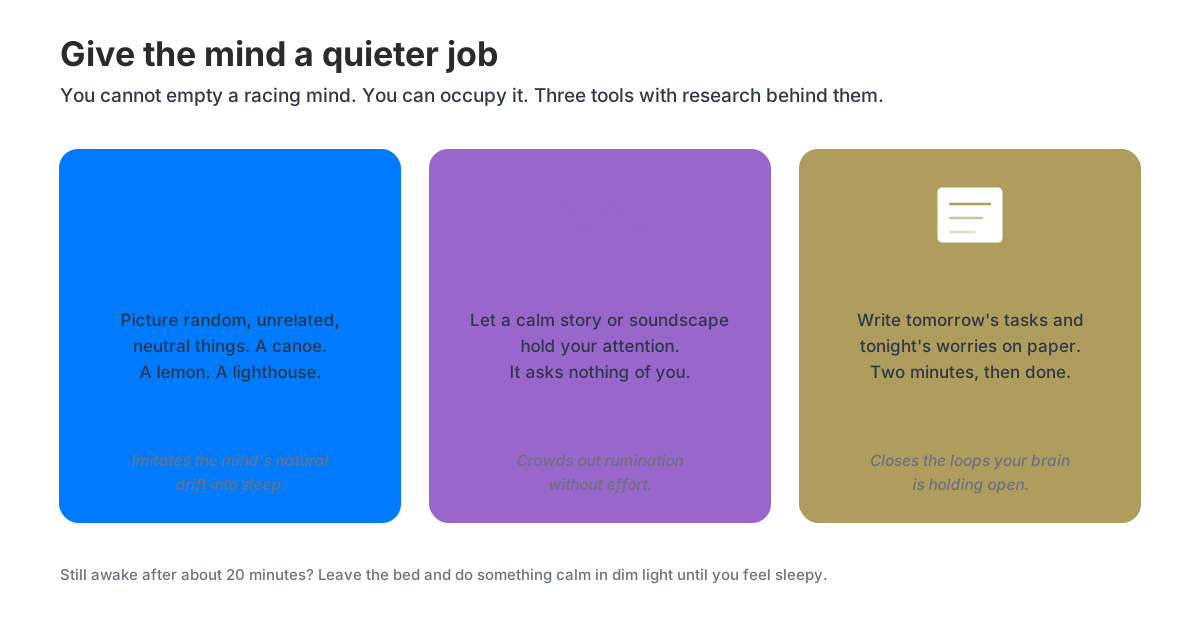
It works like this: you imagine a sequence of random, unrelated, emotionally neutral things. A canoe. A lemon. A lighthouse. A pair of boots. No story connecting them, no order, no point.
That pointlessness is the mechanism. As you naturally drift toward sleep, your thinking fragments into exactly this kind of scattered, non-sequential imagery. Shuffling imitates the brain's own falling-asleep signature, and the brain appears to read it as a signal that it is safe to stand down. At the same time, the stream of random images crowds out the sequential, goal-directed thinking that was keeping you up.
You can do it unaided: pick a word, then imagine something for each letter. It takes a little practice, and some racing minds find that even this much steering is work.
Attentional narrowing: the gentle tether
The second mechanism is the one behind purpose-built sleep audio: attentional narrowing.
A calm narrated story, or a steady natural soundscape, acts as what researchers call a gentle tether. It fills working memory with low-stakes imagery that competes directly with tomorrow's anxieties, occupying your attention just enough to interrupt rumination without demanding anything from you.
That last part matters. Meditation asks a racing mind to do something, and to do it correctly, which is precisely where anxious minds tend to fail at midnight.
The evidence here is promising and still young. A 2023 pilot trial of purpose-built sleep stories found that the share of participants with long sleep-onset times dropped from 65.7 percent to 33.3 percent. A 2025 review in the journal Sleep notes that the broader evidence base for narrated sleep audio is still at the pilot stage, thinner than the decades of data behind music and print reading. Honest summary: the mechanism is well grounded, the trials are early.
Two practical notes from the same research. Use a timer, because audio running all night can reduce deep sleep, especially for light sleepers. And if you love reading a paper book at night, keep going: print reading of calm material is one of the most consistently supported wind-down habits there is. Audio earns its place specifically for minds that reading cannot fully interrupt.
The brain dump: close the open loops on paper
The lowest-tech tool in the research is a note card.
Researchers who study high-stress professionals recommend writing down tomorrow's tasks and tonight's worries before bed. The mechanism is the completion cue again: once a worry is externalized on paper, your brain no longer needs to keep the loop open to avoid losing it. You are not solving the problem at midnight. You are scheduling it, which is the only version of solving it that bedtime allows.
Two minutes, real paper, then done.
What to do when nothing works tonight
Sleep clinicians have a safety valve for the nights when the loop will not break: if you have been lying awake for around 20 minutes, get out of bed. Sit somewhere dim and do something genuinely calm until you feel sleepy, then come back.
This comes from stimulus control, a core idea in behavioral sleep medicine from researchers like Colin Espie and Allison Harvey. Every hour spent lying in bed awake and frustrated quietly teaches your brain that bed is a place for being awake and frustrated. Leaving the bed protects the association you actually want.
And the standing caveat: if racing thoughts cost you sleep three or more nights a week, for three months or more, that pattern is worth raising with a healthcare professional, because clinical insomnia has a well-validated treatment (CBT-i) that no app or technique replaces.
The takeaway is one sentence. You cannot out-argue a racing mind at midnight, but you can give it a quieter job, and the research says it will usually take it.
References
Beaudoin, L. P. (2014). A design-based approach to sleep-onset and insomnia: super-somnolent mentation, the cognitive shuffle and serial diverse imagining. Paper presented at the 36th Annual Conference of the Cognitive Science Society, Quebec City.
Beaudoin, L. P., Digdon, N., O'Neill, K., & Racour, G. (2016). Serial diverse imagining task: a new remedy for bedtime complaints of worrying and other sleep-disruptive mental activity. Poster presented at SLEEP 2016, joint meeting of the American Academy of Sleep Medicine and the Sleep Research Society, Denver.
Economides, M., Male, R., Bolton, H., & Cavanagh, K. (2023). Feasibility and preliminary efficacy of app-based audio tools to improve sleep health in working adults experiencing poor sleep: a multi-arm randomized pilot trial. Sleep, 46(7), zsad053.
Vazzaz, J., Matcham, F., Economides, M., & Cavanagh, K. (2025). Between sound and sleep: a perspective on Sonic Sleep Aids. Sleep, 48(11), zsaf275.
This article is for general information and relaxation purposes only. It is not medical advice and is not intended to diagnose, treat, cure, or prevent any condition, including sleep disorders. If you have an ongoing sleep problem, please talk to a healthcare professional.
Give your mind somewhere calm to go
Somonic turns lights-out into something to look forward to: sleep stories built around what you choose, with soundscapes and music made for drifting off.
