Why a Story Puts You to Sleep When Silence Doesn't
2026-05-24 · 4 min read

Somewhere around age eight, most of us lost the bedtime story. We kept everything else about childhood sleep, the pillow, the dark, the closed door, but the voice that talked us down from the day disappeared, and nothing replaced it.
It turns out the voice was doing real work.
Silence hands the night to your thoughts
If your mind races at bedtime, silence is not neutral. A quiet, dark room with nothing to hold your attention is an open invitation for rumination, and rumination is electrically loud: a brain stuck in fast Beta-wave activity, the signature of alert problem-solving, cannot make the handoff into sleep.
The research on racing minds keeps arriving at the same conclusion: displacement beats suppression. You do not quiet a churning mind by giving it nothing. You quiet it by giving it something better shaped for the hour.
A story is unusually well shaped for the hour. Researchers call the mechanism attentional narrowing: a calm narrative acts as a gentle tether, filling working memory with low-stakes imagery that competes with tomorrow's worries. The story asks nothing of you. There is no technique to perform and no way to do it wrong, which is exactly where effortful practices like meditation tend to lose an anxious mind at midnight.
There is also a deeper layer. Cognitive scientist Luc Beaudoin's work on sleep onset suggests the brain reads scattered, non-sequential, unimportant imagery as a signal that it is safe to disengage, because that is what its own thinking looks like as it falls asleep. A wandering, low-stakes story delivers that signature to you, narrated, with no effort on your part.
Why not just play an audiobook?
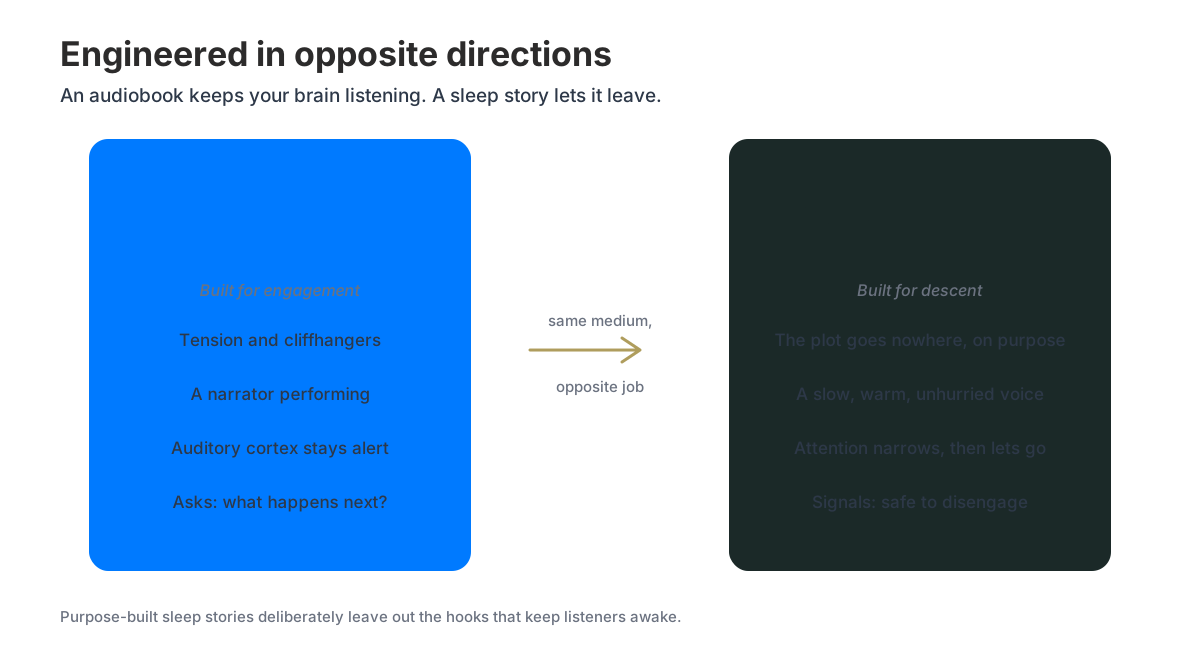
Because audiobooks are engineered to do the opposite job.
A good audiobook is built for engagement: narrative tension, stakes, cliffhangers, a narrator performing to keep you invested. Researchers note that this kind of material can keep the auditory cortex alert and listening for what happens next.
A purpose-built sleep story is engineered in reverse. The plot deliberately goes nowhere important. Nothing is at stake. The pacing slows rather than builds. And the narration itself is part of the mechanism: a slow, unhurried, warmly rhythmic voice supports the parasympathetic shift, the wind-down of heart rate and stress arousal that sleep onset requires. The voice is not decoration. Prosody is the product.
The early evidence is encouraging. In a 2023 pilot trial of purpose-built sleep stories, the share of adults with trouble falling asleep who had long sleep-onset times dropped from 65.7 percent to 33.3 percent. A 2025 review in the journal Sleep is candid that narrated sleep audio is a young research area, with less accumulated data than music or print reading. The honest claim is not that stories beat everything. It is that for racing minds specifically, a story can interrupt what reading and silence often cannot.
The ritual is half the mechanism
Behavioral sleep medicine describes bedtime routines as conditioned bridges. Pair the same calm cue with lying down, night after night, and your brain learns to automate the transition: this sound means the day is over.
This is ordinary classical conditioning, and it is also why the childhood bedtime story worked so well.
Rebuilding that as an adult takes consistency more than anything else. The research timeline for this kind of conditioning is two to four weeks of nightly repetition. Some nights improve quickly; the durable effect is earned in week three. Anyone who promises an instant fix is selling something the science does not support.
Three practical rules from the research, for any sleep audio:
- Set a timer. Audio running all night can reduce deep sleep, particularly for light sleepers. The story's job is the descent, not the whole night.
- Keep it quiet. Research-supported listening is at a low, comfortable volume. The audio should sit underneath your attention, not on top of it.
- Keep it consistent. Same ritual, same window of time. Regularity is what turns a pleasant wind-down into a conditioned one.
The boundary worth respecting
Sleep stories are a sleep hygiene tool. For the common, miserable, sub-clinical racing mind, the tired but wired state, they are a well-aimed one. But chronic insomnia, meaning three or more bad nights a week for three months or more, is a clinical condition with a validated treatment, CBT-i, delivered by professionals. No story replaces that, and you should be suspicious of any product that implies otherwise.
For everyone else, the conclusion is almost funny in its simplicity. The bedtime story was never childish. It was a correctly engineered solution to a problem adults still have, and the science is only now catching up to what every parent of a sleeping child already suspected: the right voice, saying nothing important, slowly, is one of the oldest sleep technologies we have.
References
Economides, M., Male, R., Bolton, H., & Cavanagh, K. (2023). Feasibility and preliminary efficacy of app-based audio tools to improve sleep health in working adults experiencing poor sleep: a multi-arm randomized pilot trial. Sleep, 46(7), zsad053.
Beaudoin, L. P. (2014). A design-based approach to sleep-onset and insomnia: super-somnolent mentation, the cognitive shuffle and serial diverse imagining. Paper presented at the 36th Annual Conference of the Cognitive Science Society, Quebec City.
Vazzaz, J., Matcham, F., Economides, M., & Cavanagh, K. (2025). Between sound and sleep: a perspective on Sonic Sleep Aids. Sleep, 48(11), zsaf275.
Walker, M. (2017). Why We Sleep: Unlocking the Power of Sleep and Dreams. Scribner.
This article is for general information and relaxation purposes only. It is not medical advice and is not intended to diagnose, treat, cure, or prevent any condition, including sleep disorders. If you have an ongoing sleep problem, please talk to a healthcare professional.
Give your mind somewhere calm to go
Somonic turns lights-out into something to look forward to: sleep stories built around what you choose, with soundscapes and music made for drifting off.
