Brown Noise, White Noise, or Nature Sounds: Which Helps You Sleep?
2026-06-03 · 5 min read

Somewhere around 1 AM, scrolling for anything that might help, you found out that noise has colors. White, pink, brown. People swear by brown noise for a busy mind. So which one is right, and is any of this real?
Here is the honest version, because you deserve it more than you deserve a confident sales pitch. And the most useful answer might not be a noise color at all.
What the colors actually mean
The colors describe how sound energy is spread across the frequencies you can hear.
- White noise spreads energy evenly across every frequency. It sounds bright and hissy, like static or an untuned radio.
- Pink noise tips more energy toward the lower frequencies. It sounds softer and fuller, closer to steady rain heard through a window.
- Brown noise tilts even harder toward the deep end. It sounds like a low, rumbling roar, a distant waterfall or a jet heard from far away.
That low rumble is why brown noise has become the favorite of people with racing minds. The deep, bass-heavy sound feels enveloping rather than sharp, and many busy-brained sleepers find it easier to sink into than the harsher hiss of white noise.
What the research really shows about noise colors
Now the part the viral videos skip.
In 2021, researchers published a systematic review in Sleep Medicine Reviews that pulled together the studies on continuous noise and sleep. Their conclusion was blunt: the quality of evidence that continuous noise actually improves sleep is very low. They went further and cautioned against promoting noise as a sleep aid until there is better research.
That does not mean noise is useless. It means the strong, clean proof that any color reliably puts people to sleep is not there yet. What noise does have decent support for is masking. A steady sound smooths over the sudden contrasts that jolt you awake: a door, a car, a partner shifting, the fridge cycling on. In a noisy environment, covering those spikes with something constant can genuinely protect your sleep.
So if your problem is a noisy room, any color you find comfortable, played softly, is a reasonable tool. The color that helps is mostly the one you like best. Preference is most of the point.
But masking is a defensive move. It hides a bad room. It does not actively help your body relax, and for a lot of tired people, the room was never the problem.
Why nature sounds are a different category
Here is where it gets more interesting, and more useful.
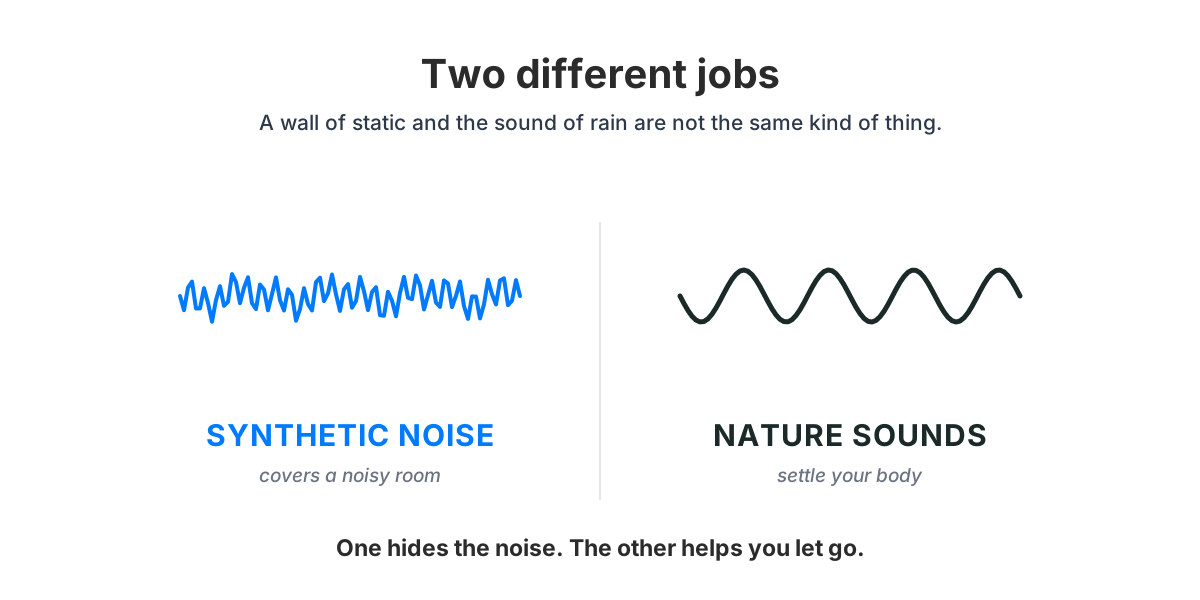
A steady wall of static and the sound of rain on leaves are not the same kind of thing, and your nervous system knows it. In a 2017 brain-imaging study, researchers had people listen to natural soundscapes and to artificial sounds while measuring their heart activity. Natural sounds produced a measurable shift toward parasympathetic activity, the rest-and-recover side of your nervous system, the exact state that lets sleep arrive. The artificial sounds did not. They were also more distracting in the attention tests.
This fits what calmer ambient audio is built to do. Recordings of rain, ocean waves, a crackling fire, or a forest at night do more than mask. They nudge your heart rate and breathing toward rest, and they hold your attention gently outward, on something soft and pleasant, instead of leaving it free to spiral inward onto tomorrow. This is the reasoning behind purpose-built sleep audio that leans on natural soundscapes rather than synthetic hiss.
When even a soundscape is not enough
There is one situation where any ambient sound, color or nature, can fall short: a genuinely racing mind.
If the thing keeping you awake is not the street but your own looping thoughts, a background wash of rain may not be enough to interrupt them. A busy brain can listen to rain and keep right on planning, rehearsing, and worrying underneath it. For that, the more reliable move is something with a thread to follow: a calm narrated story that gives the mind a low-stakes place to rest, occupying just enough attention to crowd the worry out. That is a different mechanism from both masking and ambient calm, and it is the one that tends to help when rumination is the real obstacle. We get into exactly how that works in why a story puts you to sleep when silence doesn't.
Two practical notes whatever you choose. Keep the volume low, more of a floor than a wall. And use a timer, because audio running loud all night can keep your hearing in a state of light monitoring and shallow out your deep sleep, especially if you are a light sleeper.
So which should you use
A short, honest guide.
- Noisy room, quiet mind: any noise color you find comfortable, played softly on a timer. Brown for a deep rumble, pink for a softer wash, white for the most neutral mask.
- You want to actually calm down, not just cover sound: reach for nature soundscapes. Rain, waves, fire, and forest do something static does not, which is gently steer your body toward rest.
- Quiet room, loud mind: sound alone may not be your answer. A narrated story or a structured wind-down will likely do more than any amount of static or rain.
- Either way: keep it quiet, and do not run audio at full volume all night.
Noise colors are not a scam, but they are not magic either. They are a masking tool with modest, honest evidence behind them. Nature sounds ask less of your nervous system and give it more. And when the noise keeping you up is coming from inside your own head, that is a different problem, with a different and gentler solution.
References
Riedy, S. M., Smith, M. G., Rocha, S., & Basner, M. (2021). Noise as a sleep aid: a systematic review. Sleep Medicine Reviews, 55, 101385.
Gould van Praag, C. D., Garfinkel, S. N., Sparasci, O., Mees, A., Philippides, A. O., Ware, M., Ottaviani, C., & Critchley, H. D. (2017). Mind-wandering and alterations to default mode network connectivity when listening to naturalistic versus artificial sounds. Scientific Reports, 7, 45273.
Vazzaz, J., Matcham, F., Economides, M., & Cavanagh, K. (2025). Between sound and sleep: a perspective on Sonic Sleep Aids. Sleep, 48(11), zsaf275.
This article is for general information and relaxation purposes only. It is not medical advice and is not intended to diagnose, treat, cure, or prevent any condition, including sleep disorders. If you have an ongoing sleep problem, please talk to a healthcare professional.
Give your mind somewhere calm to go
Somonic turns lights-out into something to look forward to: sleep stories built around what you choose, with soundscapes and music made for drifting off.
