Why You Can't Put Your Phone Down Before Bed
2026-06-19 · 5 min read
You got into bed at a reasonable hour. You told yourself: five minutes, then sleep. It is now well past midnight, your thumb is still moving, and you cannot quite explain where the time went or why you are still here.
If you have ever felt that quiet self-disgust at 1 AM, still scrolling, still not tired enough to stop, this is for you. The first thing to understand is that it is not really about willpower. The feed is designed to win this fight.
The signal your brain never gets
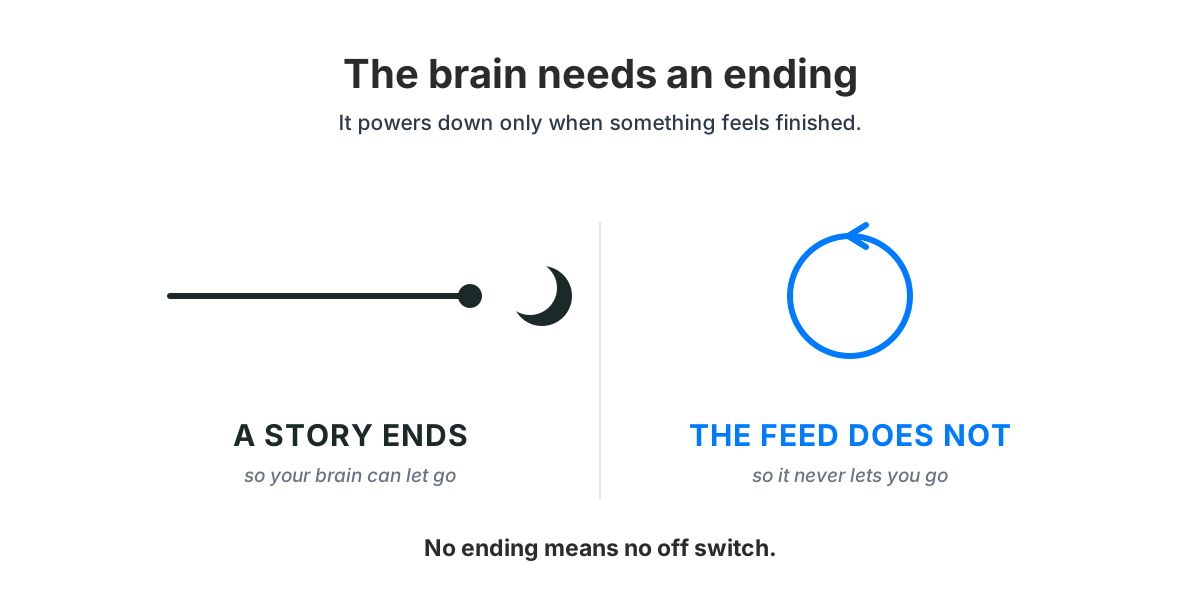
Your brain decides it is safe to power down when it senses that things are finished. A task is complete, a loop is closed, there is nothing left that needs watching. Sleep researchers talk about the brain looking for a kind of completion cue, the felt sense that you are done and can let go.
A book ends. A television episode ends. A magazine runs out of pages. Each one hands your brain a natural stopping point.
A social feed never ends. There is always one more post, and you never quite know whether the next one will be the funny, shocking, or interesting thing you are half hoping for. That uncertainty is not an accident.
This is the most powerful pattern in all of behavioral psychology: an unpredictable reward that might come with the next pull. It is the same mechanism that makes slot machines so hard to walk away from. Because you cannot predict when the good post is coming, your brain keeps you reaching for it, and the "done" signal that would let you sleep never arrives.
It is the content, not just the light
You have probably heard that the problem is blue light from the screen suppressing your melatonin. That is real, but it is the smaller half of the story, and the fixes built around it can give a false sense of safety.
The bigger problem is arousal. Researchers who study this point out that the emotional and mental activation from what you are looking at is often a more potent sleep disruptor than the light itself. An infuriating argument in the comments, an anxious piece of news, a comparison that makes you feel behind: all of it switches on your stress response and lifts you further from sleep, well after you put the phone down.
This is why a blue-light filter or night-mode glasses can be a trap. They dim the light and leave the part that actually keeps you awake completely untouched. Your screen is warmer and amber, and your nervous system is still wound up by what you fed it.
How often you reach for the feed matters too. In a large study of young adults, the people who checked social media most frequently had nearly three times the odds of disturbed sleep, a stronger link than total minutes spent. It is the constant checking, the reaching for the next hit, that tracks with worse nights.
The feeling that lured you in
There is one more piece worth naming, because it makes the whole thing feel less like a personal failing.
That alert, slightly restless energy you feel late in the evening is partly real biology. There is a small rise in alertness that tends to show up an hour or two before your usual sleep time. It can fool you into thinking you are not tired yet, and the phone is right there to fill the gap. So you scroll into the wired window instead of through it. We unpack that wide-awake-at-the-wrong-time feeling in tired but wired: why your brain won't shut off at night.
What works better than willpower
You will not out-discipline a system engineered by very smart people to hold your attention. The move is to swap it for something that gives your brain the ending it is looking for, rather than denying it.
A few options with real support behind them.
Read something on paper. Print reading of calm, pleasant material is one of the most consistently supported wind-down habits there is. The page ends, and so does the loop.
Do a two-minute brain dump. Write tomorrow's worries and tasks on a note card. Once a worry is on paper, your brain can stop holding it open, which is the completion cue in its simplest form.
Hand your attention to a story instead of a feed. A calm narrated sleep story does something the feed refuses to: it has a shape, a slow pace, and an end. It occupies the same restless attention the scroll was feeding on, but it is built to wind down rather than wind up. This is not the same as putting on any podcast or audiobook, which are engineered to keep you listening through tension and cliffhangers. Purpose-built sleep audio deliberately removes the hooks.
The honest caveat: none of these are a switch that works the first night. Breaking the bedtime-scroll habit is a retraining job, and giving your attention a calmer home takes a couple of weeks of repetition before the new pattern feels automatic. And if anxiety keeps you scrolling and awake several nights a week for months, that is worth raising with a healthcare professional, because there are proven treatments for chronic insomnia that go beyond sleep habits.
But the reframe helps on its own. You are not weak for losing an hour to the feed. You were playing a game that was rigged. The fix is not to try harder at a rigged game. It is to stop playing it, and give your tired brain the ending it has been waiting for.
References
Levenson, J. C., Shensa, A., Sidani, J. E., Colditz, J. B., & Primack, B. A. (2016). The association between social media use and sleep disturbance among young adults. Preventive Medicine, 85, 36-41.
Vazzaz, J., Matcham, F., Economides, M., & Cavanagh, K. (2025). Between sound and sleep: a perspective on Sonic Sleep Aids. Sleep, 48(11), zsaf275.
Economides, M., Male, R., Bolton, H., & Cavanagh, K. (2023). Feasibility and preliminary efficacy of app-based audio tools to improve sleep health in working adults experiencing poor sleep: a multi-arm randomized pilot trial. Sleep, 46(7), zsad053.
This article is for general information and relaxation purposes only. It is not medical advice and is not intended to diagnose, treat, cure, or prevent any condition, including sleep disorders. If you have an ongoing sleep problem, please talk to a healthcare professional.
Give your mind somewhere calm to go
Somonic turns lights-out into something to look forward to: sleep stories built around what you choose, with soundscapes and music made for drifting off.
