Why You Wake at 3 AM and Can't Fall Back Asleep
2026-06-11 · 5 min read

You fell asleep fine. That was the easy part.
Then your eyes open in the dark, your heart is going a little too fast, and the clock says some version of 3 AM. Within seconds your mind has found a worry to hold, and the worry feels enormous, far bigger than it will look at breakfast. Now you are wide awake, and the harder you try to fall back asleep, the more awake you become.
This is one of the most common sleep complaints there is, and it is not a character flaw or a sign that you are bad at sleeping. The early-hours wake-up has a physiology.
Why the body wakes in the small hours
Sleep is not one long flat state. You move through cycles, and in the second half of the night those cycles get lighter and dreaming gets longer. You are simply closer to the surface at 3 AM than you were at midnight, so it takes less to tip you awake.
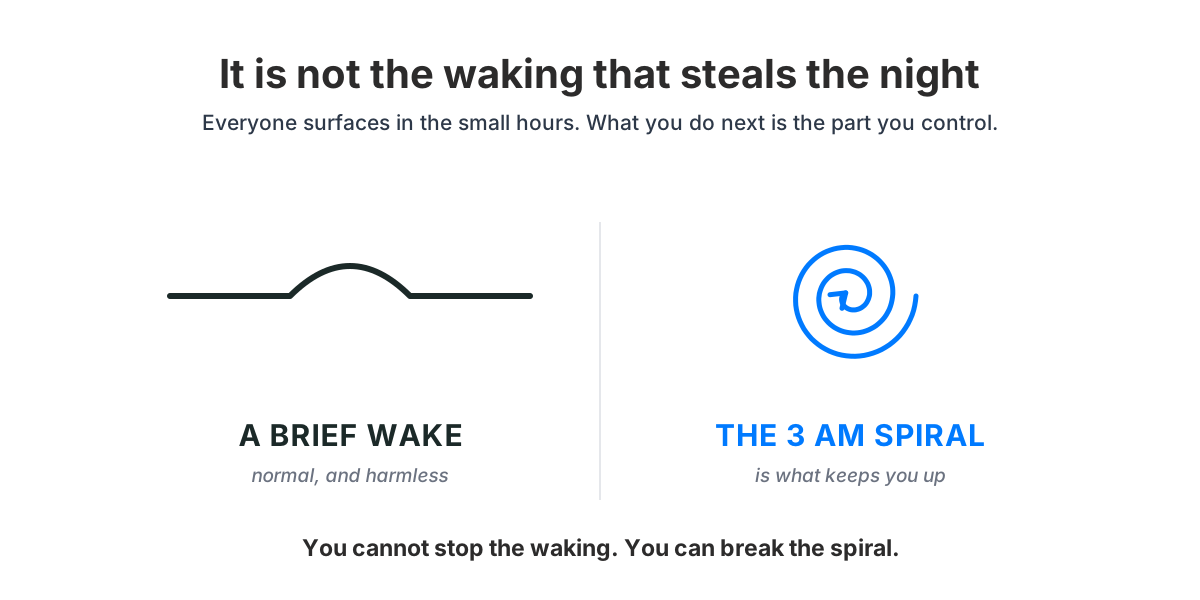
What tips you can be ordinary: a shift in temperature, a full bladder, a noise outside. The problem is rarely the wake-up itself. Almost everyone surfaces briefly several times a night and never remembers it. The problem is what your nervous system does next.
In the small hours, a brief arousal can flip into full alertness. The stress response switches on, the heart rate climbs, and the mind, handed a quiet dark stage, immediately reaches for the most unresolved thing it can find. Cortisol, the hormone that should be at its lowest point around the middle of the night and rising only toward morning, gets nudged up early by that surge of arousal. Once it is up, settling back down is genuinely harder, because your body has been told, briefly, that something needs attention.
When hormones change the picture
For many women in their forties and fifties, the 3 AM wake-up arrives or sharply worsens during perimenopause, and there is a clear reason why.
Progesterone has a calming, sleep-promoting effect. It works partly through the same brain receptors that anti-anxiety medication targets, which is why a 2025 review in the Journal of Clinical Medicine describes it as having a sedative and anxiolytic action. As progesterone declines through the menopause transition, that built-in calming buffer fades, and the nervous system becomes easier to startle awake.
Estrogen falls too, and with it goes some of the body's temperature stability. The same review notes that nighttime hot flashes disrupt sleep, and that women with more frequent and severe symptoms are more likely to report insomnia. A flash or a sweat is itself an arousal: the body briefly misreads its own temperature and reacts, and you wake.
If this is your pattern, the wake-up is not in your head. It is a real shift in the chemistry that holds sleep together, and it deserves to be treated as such, including a conversation with a doctor if hot flashes and night sweats are wrecking your nights.
What actually helps you settle
The instinct at 3 AM is to lie still, shut your eyes hard, and demand sleep. That instinct is the trap. Lying in bed awake and frustrated quietly teaches your brain that bed is a place for being awake and frustrated, which makes tomorrow night a little worse.
A few things have evidence behind them.
Cool the room. Falling and staying asleep depends on your core temperature dropping slightly, by a couple of degrees. A bedroom around 65 to 68 degrees, with some airflow, supports that drop and gives a flushed, overheated body somewhere to shed heat. This matters most if temperature swings are part of why you wake.
Do not fight the bed. Sleep clinicians use a simple rule: if you have been awake for around 20 minutes and you are wired, get out of bed. Sit somewhere dim, do something genuinely dull and calm, and go back when you feel sleepy. You are protecting the association between your bed and sleep instead of slowly eroding it.
Give the mind a quieter job. A racing 3 AM mind will not be argued into silence, but it can be occupied. This is where calm narrated audio earns its place. A steady, low-stakes story or soundscape acts as a gentle tether for attention: it fills the mental space the worry wants, without demanding that you concentrate or perform. When your own internal calming chemistry is running low, an external anchor can stand in for it. This is the same mechanism explored in why a story puts you to sleep when silence doesn't.
The honest fine print
A few caveats worth keeping.
Calm audio is a sleep-hygiene tool, not a treatment. If your wake-ups are driven by hot flashes and night sweats, the audio can settle your mind, but the temperature problem itself may need cooling strategies or medical advice. Use a timer too: audio running all night long can shallow out your deep sleep, especially if you are a light sleeper.
And the standing line: if you are waking and struggling to fall back asleep three or more nights a week, for three months or more, that pattern is worth raising with a healthcare professional. Chronic insomnia has a well-validated treatment, a structured therapy called CBT-i, that no app or technique replaces.
The 3 AM wake-up feels like a private failure at the time. It is closer to a predictable piece of biology. You cannot always stop the waking, but you can change what happens in the ten minutes after, and that is usually where the night is won or lost.
References
Troïa, L., Garassino, M., Volpicelli, A. I., et al. (2025). Sleep disturbance and perimenopause: a narrative review. Journal of Clinical Medicine, 14(5), 1479.
Economides, M., Male, R., Bolton, H., & Cavanagh, K. (2023). Feasibility and preliminary efficacy of app-based audio tools to improve sleep health in working adults experiencing poor sleep: a multi-arm randomized pilot trial. Sleep, 46(7), zsad053.
Walker, M. (2017). Why We Sleep: Unlocking the Power of Sleep and Dreams. Scribner.
This article is for general information and relaxation purposes only. It is not medical advice and is not intended to diagnose, treat, cure, or prevent any condition, including sleep disorders. If you have an ongoing sleep problem, please talk to a healthcare professional.
Give your mind somewhere calm to go
Somonic turns lights-out into something to look forward to: sleep stories built around what you choose, with soundscapes and music made for drifting off.
